Dubai publishes more property data than almost any market on earth, and the result is that any claim about it can be supported by some figure somewhere. This page collects the ones that actually describe the market in 2026, with the period and the source attached to each, because a Dubai statistic without a date and a scope is close to useless.
All figures are as at the third quarter of 2026 unless stated otherwise.
How Many Property Transactions Did Dubai Record in Q3 2026?
36,738 transactions worth AED 90.62 billion, on Dubai Land Department data published on 5 October 2026. Residential property accounted for AED 72.58 billion across 33,949 transactions.
| Q3 2026 measure | Figure |
|---|---|
| Total transactions | 36,738 |
| Total value | AED 90.62 billion |
| Residential transactions | 33,949 |
| Residential value | AED 72.58 billion |
| Share of deals below AED 3 million | more than 84% |
| Most active location | Dubai South, 5,165 transactions |
You will also see Q3 2026 reported at roughly AED 93 billion and about 37,000 deals. The difference is scope rather than error, and it is the first lesson of reading Dubai data: totals vary with which categories, registration types and reporting cut-off a publisher uses. Quote the source alongside the number.
The context that matters more than the quarter: 2025 closed at more than 270,000 transactions worth AED 917 billion, up about 20% on 2024's AED 761 billion. Against a record year, a quarter at AED 91 billion is a decline from an exceptional peak rather than a collapse from a normal one.
What Is the Average Price per Square Foot in Dubai in 2026?
It depends entirely on the property type, and the ranking is not the one most people expect.
| Property type, Q3 2026 | Average price per sq ft |
|---|---|
| Villas | AED 2,216 |
| Apartments | AED 1,794 |
| Townhouses | AED 1,341 |
| Dubai South, all types | AED 1,690 |
Citywide, average prices stood at about AED 1,636 per square foot in August 2026, down 1.7% year on year, which was the first annual decline since February 2021. The ValuStrat Price Index measured residential values down about 3.1% year on year over the same stretch.
That modest softening sits underneath a market where more than 84% of transactions close below AED 3 million. Dubai is, by volume, a mid-market city that contains a prime segment, not a prime city.
Why Do Two Reports Say Opposite Things About the Same Quarter?
Because one is reporting an average deal size and the other an index of value per unit of area, and in Q3 2026 those moved in opposite directions.
One large Dubai agency reported its average sale price up 14% quarter on quarter to AED 5,447,110, while market-wide measures put apartment pricing down 4.8% quarter on quarter. Both were accurate. Transactions above AED 10 million rose about 38% quarter on quarter, so the mix of deals got larger while the price per square foot eased.
The rule that follows is worth more than any single figure on this page. When two Dubai price statistics contradict each other, check whether one is an average of deals and the other a per-area index before concluding that either is wrong. An average of transactions describes whoever's book it came from. An index describes the market.
Are Dubai Rents Rising or Falling in 2026?
Both, and which one you see depends entirely on whether you are signing a new contract or renewing an old one.
| Rental measure, Q3 2026 | Change |
|---|---|
| New-contract apartment rents, year on year | down about 2.3% |
| New-contract villa rents, year on year | down about 11.1% |
| Renewal apartment rents, year on year | up about 3.4% |
| Renewal villa rents, year on year | up about 10.3% |
| ValuStrat Dubai rental index, quarter on quarter | down 4.9% |
| REIDIN residential rent index, September 2026 year on year | down about 6.8% |
Asking rents in several districts fell considerably further: Meydan down about 13%, Business Bay about 12.5% and Jumeirah Village Circle about 10%, with Downtown asking rents on some unit types reported down from roughly AED 230,000 to AED 180,000 year on year.
The split is a direct product of how Dubai regulates rent. Renewals are governed by Decree No. 43 of 2013 and the Smart Rental Index, which allows an increase only where the existing rent sits below the index by defined margins, so sitting tenants drift upward toward the index regardless of where the open market goes. New contracts are unregulated and reprice immediately. A record handover wave is landing on the new-contract side of that wall and not on the renewal side.
How Much New Supply Is Dubai Actually Delivering?
Less than the headline pipeline, and the gap is the most misreported number in the market.
Roughly 120,000 residential units were scheduled for handover across Dubai in 2026 at the start of the year. Knight Frank put realistic completions at about 46% of planned supply, which is nearer 33,000 to 34,000 actual handovers. Dubai crossed 10,000 apartment handovers in a single month twice in early 2026.
Planned supply in Dubai has historically slipped, and treating the pipeline figure as delivery is how forecasts of a glut get written. The right reading is that a large but not unprecedented amount of stock is arriving, concentrated in the districts that sold hardest off-plan.
Off-plan's share of sales also varies more than most summaries admit: 66% of sales between January and July 2026, against 72.1% in Q1 and about 76% in Q2 on other counts. The direction is consistent even where the level is not — Dubai remains an off-plan-led market.
What Is Driving Demand? The Population Number
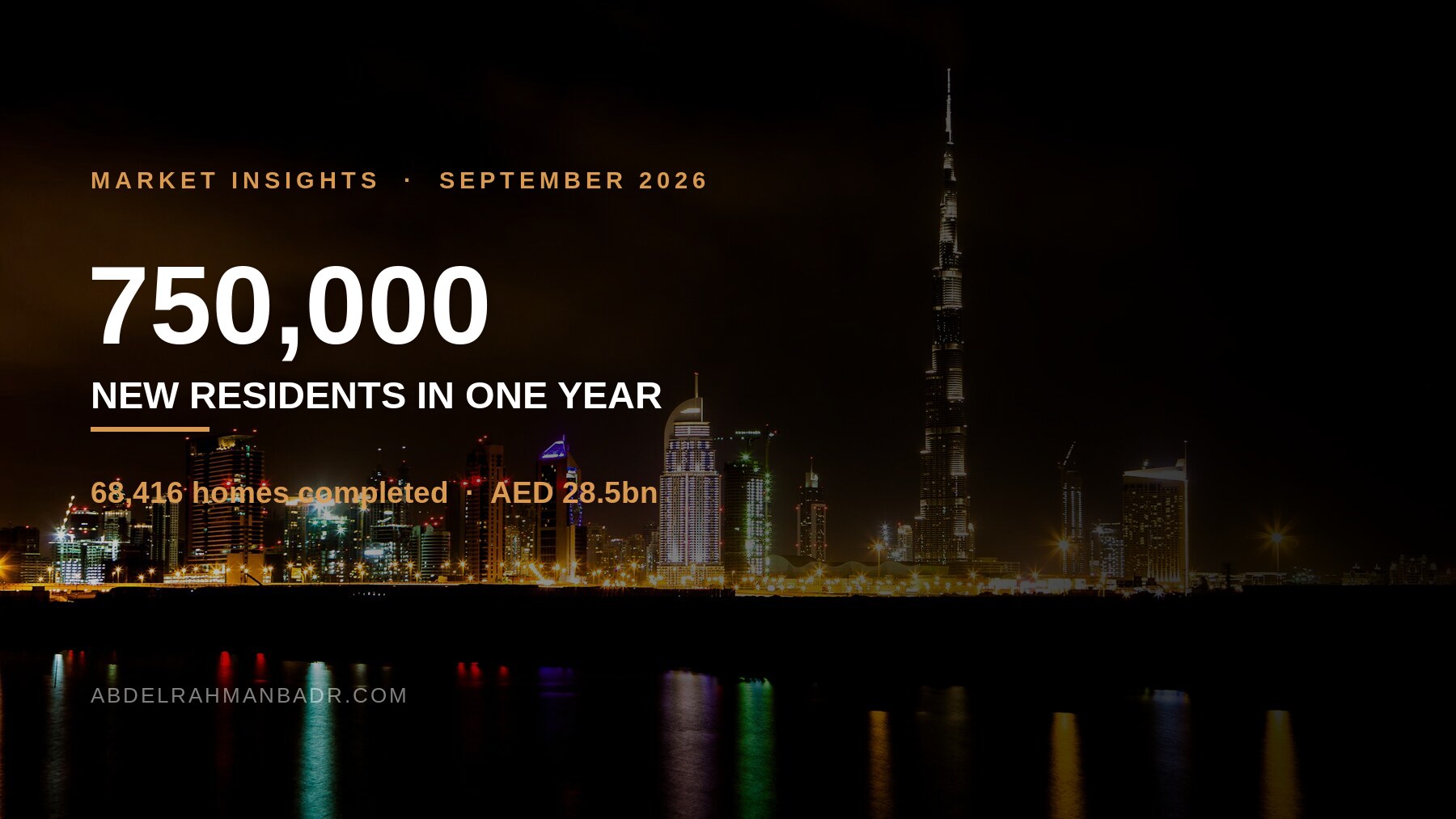
Dubai's population stood at 4,787,277 in August 2026, up 18.6% on the 4,036,863 recorded in August 2025 — roughly 750,000 additional residents in a single year. The emirate counted 1.93 million people in 2011.
Set that against 33,000 to 34,000 realistic handovers and the arithmetic answers itself. A city adding three quarters of a million residents a year while delivering tens of thousands of homes is not oversupplied in aggregate, whatever is happening in any individual district. Price softening in 2026 is a repricing within a growing market, not a demand failure.
What Does It Cost to Buy and Sell in Dubai?
The transaction costs have not moved in 2026 and are the most quoted figures on this site.
| Cost | Amount |
|---|---|
| DLD transfer fee | 4% of price plus AED 580 admin |
| Agency commission | 2% plus 5% VAT |
| Registration trustee fee | AED 4,000 below AED 500,000, AED 4,200 at or above, plus VAT |
| Mortgage registration | 0.25% of the loan plus AED 290 |
| Total cost of buying, cash | about 6.5% of price |
| Total cost of buying, with a mortgage | about 9% of price |
| Total cost of selling | about 2.2% of price |
| Round trip, buy then sell | about 8.7% of price |
That 8.7% round trip is the figure that decides whether buying beats renting over a given holding period, and it is unaffected by whichever way the index moved last quarter.
The Figures in One Place
| Measure | 2026 value |
|---|---|
| Q3 2026 transactions | 36,738 worth AED 90.62 billion |
| 2025 full year | 270,000+ transactions worth AED 917 billion |
| Average price, August 2026 | about AED 1,636 per sq ft, down 1.7% year on year |
| Villas / apartments / townhouses | AED 2,216 / AED 1,794 / AED 1,341 per sq ft |
| Deals below AED 3 million | more than 84% |
| Gross rental yields | about 4% prime to 8% to 10% in Deira |
| Planned 2026 handovers | about 120,000 units, roughly 46% realistically delivered |
| Population, August 2026 | 4,787,277, up 18.6% year on year |
| Round-trip transaction cost | about 8.7% |
The Short Version
Dubai recorded 36,738 transactions worth AED 90.62 billion in Q3 2026 on DLD data published 5 October 2026, with more than 84% of deals below AED 3 million and Dubai South the most active district. Average prices eased to about AED 1,636 per square foot in August 2026, down 1.7% year on year and the first annual fall since February 2021, against a 2025 that closed at more than 270,000 deals worth AED 917 billion. Villas average AED 2,216 per square foot, apartments AED 1,794 and townhouses AED 1,341. Rents are falling for new tenants and still rising for renewing ones because Decree No. 43 of 2013 and the Smart Rental Index govern renewals while new contracts reprice freely. About 120,000 units were scheduled for handover in 2026 but roughly 46% is the realistic completion rate. And the population reached 4,787,277 in August 2026, up 18.6% in a year, which is why a softening price index is better read as a repricing than as a demand problem.
Frequently Asked Questions
01How many property transactions did Dubai record in 2026?
Dubai recorded 36,738 transactions worth AED 90.62 billion in the third quarter of 2026, on Dubai Land Department data published on 5 October 2026, of which residential property accounted for AED 72.58 billion across 33,949 transactions. Some publishers report the same quarter at roughly AED 93 billion and about 37,000 deals because scopes and cut-offs differ. For context, 2025 closed at more than 270,000 transactions worth AED 917 billion, up about 20% on 2024.
02What is the average property price per square foot in Dubai in 2026?
About AED 1,636 per square foot citywide in August 2026, down 1.7% year on year, which was the first annual decline since February 2021. By type in Q3 2026 villas averaged AED 2,216 per square foot, apartments AED 1,794 and townhouses AED 1,341, while Dubai South averaged AED 1,690 across all types. The ValuStrat Price Index measured residential values down about 3.1% year on year over the same period.
03Is the Dubai property market crashing in 2026?
No. Prices eased about 1.7% year on year to August 2026 and quarterly volumes fell from an exceptional 2025 base of more than 270,000 transactions worth AED 917 billion, which is a decline from a record rather than from a normal year. Meanwhile Dubai's population reached 4,787,277 in August 2026, up 18.6% in twelve months, against realistic 2026 handovers of roughly 33,000 to 34,000 units. The sensible reading is a repricing inside a growing market, concentrated in districts that sold hardest off-plan.
04Why do Dubai property reports contradict each other?
Usually because one is an average of transaction values and the other is an index of price per square foot. In Q3 2026 one large agency reported its average sale price up 14% quarter on quarter to AED 5,447,110 while market-wide measures showed apartment pricing down 4.8% quarter on quarter. Both were correct: deals above AED 10 million rose about 38%, so the mix of transactions got larger while the price per unit of area fell. Check which kind of statistic you are reading before concluding either is wrong.
05How much new property supply is being delivered in Dubai?
About 120,000 residential units were scheduled for handover across Dubai in 2026, but Knight Frank put realistic completions at roughly 46% of planned supply, or about 33,000 to 34,000 actual handovers. Dubai crossed 10,000 apartment handovers in a single month twice in early 2026. Planned pipelines in Dubai have historically slipped, so treating the scheduled figure as delivery is the most common way a supply-glut forecast gets built on sand.
06What percentage of Dubai property sales are off-plan?
Roughly two thirds to three quarters, depending on the period and the counting method. Off-plan accounted for 66% of sales between January and July 2026, while other counts put it at 72.1% in the first quarter and about 76% in the second. The level moves but the direction does not: Dubai remains an off-plan-led market, which is also why registration in the Interim Property Register through Oqood under Law No. 13 of 2008 matters to so many buyers.