Two apartments are advertised at 1,100 square feet in the same tower, at the same price, by two different agencies. One has 1,100 square feet of floor inside the front door. The other has 940, plus a 160-square-foot balcony.
Neither listing is lying. They are quoting different areas, and in Dubai nobody is obliged to tell you which one they used.
This is not a rounding problem. Area determines what you pay the owners association every year, how large your share of the building is, and whether the price per square foot you used to compare two units was comparing anything at all.
Which Area Figure Legally Matters in Dubai?
The area of your unit as recorded in the Real Property Register — the figure on your title deed. Everything else is description. That one is operative, and Law No. 6 of 2019 Concerning Ownership of Jointly Owned Real Property in the Emirate of Dubai gives it two jobs.
Article 25 sets your service charge: an owner pays the management entity a share of the annual service charges calculated, using the relevant method approved by the Director General, based on the ratio of the area of the owner's unit to the total area of the jointly owned real property — and expressly, the share is calculated on the area of the unit as recorded in the Real Property Register.
Article 11 sets your stake in the building itself: an owner holds an undivided interest in the common parts, determined by the ratio of the unit area to the total area of the jointly owned real property.
So the registered area is not a label. It is the multiplier on a bill you will pay every year for as long as you own the apartment, and it is the measure of how much of the building you own. At AED 15 per square foot, a 160-square-foot discrepancy is AED 2,400 a year — about AED 24,000 over a decade of ownership, on a number nobody checked.
Note the wording "using the relevant method approved by the Director General". The law fixes the base as the registered area but delegates the method. That is the clause under which administrative practice — such as treating balcony area differently from internal area in the apportionment — actually lives. It is not in the statute, which is why practice on balconies has shifted over time and why your building's own invoice is the thing to read rather than a general rule.
What Do BUA, Suite Area and Net Area Actually Mean?
The vocabulary is used loosely in the market, which is half the problem. The working definitions:
| Term | What it usually means | Where you see it |
|---|---|---|
| Suite area, or net area | The enclosed internal floor area of the unit, measured inside the walls | Floor plans, some developer specifications |
| Balcony or terrace area | Private external space, measured separately | Stated separately on a good floor plan, folded into the headline on a bad one |
| Built-up area, BUA | The unit's total floor area measured to the external wall faces, taking in internal walls and, in Dubai practice, covered balcony area | Brochures, listings, and commonly the title deed |
| Gross floor area, GFA | A planning measure for a whole building | Development approvals, the leasehold-to-freehold conversion fee base |
| Plot area | The land itself, for a villa or townhouse | Villa listings, title deeds for land |
The trap is that suite area and BUA are both honestly describable as "the size of the apartment", and they can differ by fifteen per cent or more in a unit with generous balconies. An agency quoting BUA and an agency quoting suite area will produce two different prices per square foot for the identical unit, and the one quoting the larger area will look cheaper.
For villas and townhouses there is a second layer: BUA and plot area are different numbers, and a listing that quotes only one of them has told you either how much house there is or how much land there is, not both.
Where Does Your Apartment Actually Stop?
This is the question nobody asks, and Law No. 6 of 2019 answers it precisely — with a result that surprises most owners.
Article 9 describes what a unit comprises: the internal area, the non-structural internal walls, the floors and flooring materials down to the base of the joists, and the interior elements within it. It expressly excludes utility services inside the unit that serve the common parts or any other unit.
Article 7 puts the rest on the other side of the line. The structural components of the jointly owned property — main supports, foundations, columns, structural walls, ceilings, ceiling joists, staircases, stairwells, facades and roofs — are common parts.
So the glass wall your living room looks through is not yours. The structural wall between you and your neighbour is not yours. The roof above the top-floor apartment is not the top-floor owner's. You own the volume and the finishes; the building owns its own structure, and you own an undivided share of that building in proportion to your registered area.
Two practical consequences follow immediately, and both are routinely discovered the hard way:
- A facade is a common part, so replacing or altering glazing is not a decision an owner takes alone. Law No. 6 of 2019 Article 39(a) requires three approvals for substantial alteration to a unit's structure or external appearance — the master developer, the Dubai Land Department and the competent authority. Most renovation guides mention municipality approval and an owners association NOC and omit the DLD entirely.
- Water ingress through a facade or a roof is usually a common-parts problem, which makes it the management entity's responsibility to repair and, ultimately, something all owners fund through service charges. That is better news than it sounds for the individual owner, and worse news than it sounds for everyone's budget.
Is the Balcony Included in the Area You Pay For?
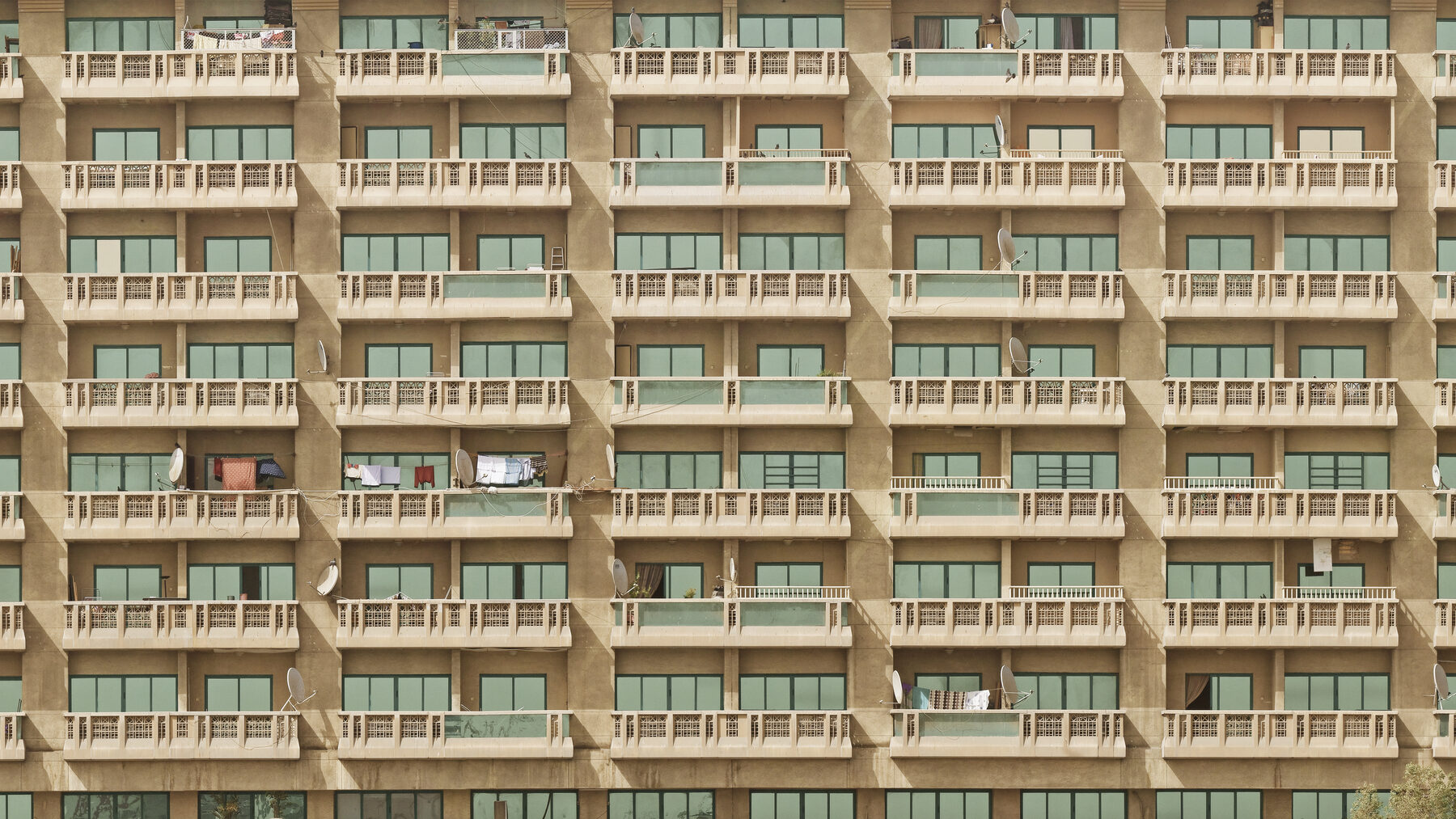
Usually yes in the registered area, and this is the single most common surprise on a first service charge invoice. In Dubai practice the title deed figure for an apartment generally takes in the balcony as well as the enclosed space, which is what makes a brochure's "1,100 sq ft" and a floor plan's "940 sq ft internal" both true at once.
How the balcony is then treated in the apportionment is administrative rather than statutory, because Article 25 delegates the method to an approach approved by the Director General. Practice has not been constant over the years, and it can differ between buildings.
Which produces a short, concrete instruction rather than a rule: before you buy, get the actual service charge invoice for that unit or an identical one in the building, and check the area the invoice is calculated on. Not the index rate, not the brochure, not the agent's estimate. The invoice. It is the only document that shows you which area number the building is actually billing.
The Land Department publishes a Service Charge Index of RERA-approved rates per square foot by project, searchable on the DLD website and the Dubai REST app, and charges are collected through Mollak into approved escrow accounts. The index gives you the rate. The registered area gives you the multiplier. You need both, and buyers almost always look up only the first.
How Do You Check the Area Before You Commit?
Three checks, in this order, and none of them takes long.
First, read the title deed, not the listing. The deed records the area in square metres alongside the owner, plot, unit number and project. On a resale this is available to you through the seller and verifiable through Dubai REST. If a listing's headline area and the deed's area disagree, the deed is the one with consequences. Note the unit conversion as well: deeds are in square metres, listings are in square feet, and 1 square metre is about 10.764 square feet. A surprising number of apparent discrepancies are a conversion done carelessly.
Second, on off-plan, read the area-variance clause in the sale and purchase agreement. There is no statutory tolerance in Dubai. What governs is whatever the SPA says — commonly a stated percentage within which no adjustment is made, and a mechanism above it. Three questions to ask of that clause: what is the tolerance, is the adjustment two-way or only in the developer's favour, and at what price per square foot is any adjustment settled. A clause that compensates at the original price per square foot in a market that has risen is not compensation.
Third, at handover, measure. Snagging inspections concentrate on finishes, and area is checked far less often than it should be, despite being the one defect that is impossible to remedy after the fact. Ask for the measurement to be done against the registered area, and raise any shortfall before you take possession rather than after.
Why Two Listings for the Same Unit Can Show Different Sizes
Put the pieces together and the opening puzzle resolves. There is no single mandated area figure for marketing in Dubai, the registered figure generally includes balcony area, and nothing obliges a listing to say which basis it used. So:
- An agency quoting BUA produces a bigger area and a lower price per square foot.
- An agency quoting suite area produces a smaller area and a higher price per square foot.
- Both can be describing the same apartment at the same price.
The only way to compare two units honestly is to normalise them to the registered area before you look at the price per square foot — and to treat a large balcony as what it is. It is real space with real value, and it is also real area that you will pay service charges on every year for as long as you own the property. The question is not whether that is fair. It is whether you priced it.
The Short Version
- The number with legal consequences is the area of the unit as recorded in the Real Property Register, not the brochure's.
- Article 25 of Law No. 6 of 2019 calculates your service charge on it. Article 11 sizes your share of the common parts by it.
- Your unit is the internal area and non-structural internal walls under Article 9. Structural walls, facades and roofs are common parts under Article 7.
- Altering anything structural or external needs three approvals under Article 39(a), including the DLD, which most renovation guides omit.
- The registered area for an apartment generally includes the balcony. How the balcony is treated in the apportionment is administrative, so read the building's own invoice.
- Use the DLD Service Charge Index for the rate and the title deed for the area. Both, not one.
- Off-plan, the area-variance clause in the SPA is the only tolerance there is. Check whether it works in both directions.
- Deeds are in square metres, listings in square feet. Convert before concluding that something is wrong.
Frequently Asked Questions
01Which area figure is used to calculate service charges in Dubai?
The area of your unit as recorded in the Real Property Register, which is the figure on your title deed. Article 25 of Law No. 6 of 2019 provides that an owner's share of the annual service charges is calculated, using the relevant method approved by the Director General, based on the ratio of the area of the owner's unit to the total area of the jointly owned real property, and that the share is calculated on the area of the unit as recorded in the register. The brochure figure and the floor plan figure have no role in that calculation.
02What is the difference between BUA and suite area in Dubai?
Suite area, sometimes called net area, is the enclosed internal floor area of the unit measured inside the walls. Built-up area, or BUA, is the unit's total floor area measured to the external wall faces, taking in internal walls and, in Dubai practice, covered balcony area. The two can differ by fifteen per cent or more in a unit with generous balconies, and because nothing obliges a listing to state which basis it used, an agency quoting BUA will show a lower price per square foot than an agency quoting suite area for the identical apartment.
03Do I pay service charges on my balcony in Dubai?
In most cases the registered area for an apartment takes in the balcony as well as the enclosed space, so it forms part of the base your service charge is calculated on. How the balcony is weighted within that calculation is administrative rather than statutory, because Article 25 of Law No. 6 of 2019 delegates the method to an approach approved by the Director General, and practice has varied over time and between buildings. The reliable check is to obtain the actual service charge invoice for that unit or an identical one in the building and look at the area the invoice is calculated on.
04Does an apartment owner in Dubai own the balcony glass and the exterior wall?
No. Article 9 of Law No. 6 of 2019 defines a unit as the internal area, the non-structural internal walls and the floors down to the base of the joists, while Article 7 places the structural components, including main supports, foundations, columns, structural walls, ceilings, joists, staircases, facades and roofs, in the common parts. An owner holds an undivided interest in those common parts proportionate to their unit area under Article 11. In practice this means glazing and facades are not an owner's to alter unilaterally, and that substantial alteration to a unit's structure or external appearance requires three approvals under Article 39(a), from the master developer, the Dubai Land Department and the competent authority.
05What happens if the delivered apartment is smaller than the one I bought off-plan?
The answer comes from your sale and purchase agreement, because Dubai has no statutory area tolerance. SPAs commonly state a percentage variance within which no adjustment is made and a mechanism for anything beyond it. Three things are worth checking in that clause before signing: the size of the tolerance, whether the adjustment works in both directions or only in the developer's favour, and the price per square foot at which any adjustment is settled, since compensation at the original rate in a market that has risen is not full compensation. Measure against the registered area at handover and raise a shortfall before taking possession.
06How do I check a Dubai property's real size before buying?
Read the title deed rather than the listing, since the deed records the area in square metres alongside the owner, plot, unit number and project, and a resale deed can be verified through Dubai REST. Convert carefully, because deeds are in square metres and listings in square feet at about 10.764 square feet to the square metre, and many apparent discrepancies are simply a careless conversion. Then look up the project on the Land Department's Service Charge Index for the approved rate per square foot, and multiply it by the registered area rather than by the advertised one.