Tilal Al Ghaf is Majid Al Futtaim's answer to a question most Dubai villa communities avoid: what happens if you put the amenity in the middle instead of at the edge?
The masterplan is organised around Lagoon Al Ghaf, a swimmable crystal lagoon with sandy beaches, and every neighbourhood in the community is priced by its relationship to that water. A townhouse three streets back and a beachfront villa are the same developer, the same finish standard and the same service charge schedule, separated by a price gap that exists almost entirely because of walking distance to a man-made lake.
Whether that gap is worth paying is the only question this guide is really about.
Where It Is and What Is In It
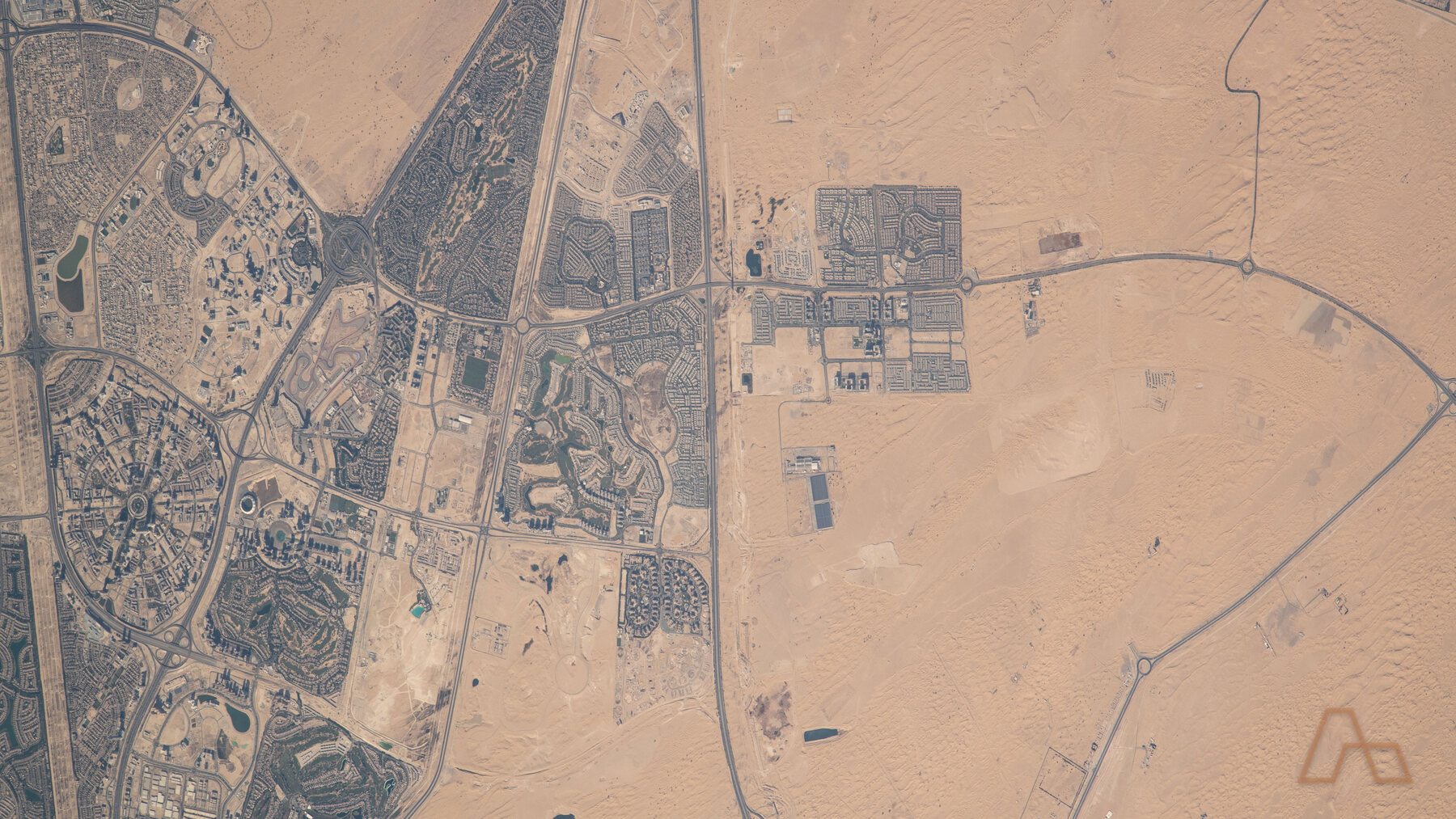
Tilal Al Ghaf sits in Dubailand, reached from Sheikh Zayed Bin Hamdan Al Nahyan Street (D54) and Hessa Street (D61), with onward connections to Al Khail Road (E44), Sheikh Mohammed Bin Zayed Road (E311) and Emirates Road (E611). It is an inland community on the Dubai to Al Ain side of the city, not a coastal one, and the drive times reflect that.
| Feature | Tilal Al Ghaf |
|---|---|
| Developer | Majid Al Futtaim |
| Position | Dubailand, off D54 and Hessa Street D61 |
| Centrepiece | Lagoon Al Ghaf, swimmable, with sandy beaches |
| Neighbourhoods | Twelve, from townhouses to mansions |
| Drive to Dubai Marina | About 20 to 25 minutes off-peak |
| Drive to Downtown Dubai | About 25 to 30 minutes off-peak |
| Nearest schools | Dwight School Dubai and GEMS Metropole, around 6 minutes |
| Nurseries | The Wonder Years and Dibber, around 12 minutes |
| Clinics | Aster Clinic and Medcare, around 10 minutes |
| Metro | None, and none planned on the current network map |
The twelve neighbourhoods are Elan, Aura, Harmony, Alaya, Elysian Mansions, Lanai Islands, Serenity Mansions, Plagette 32, Amara, Aura Gardens, Alaya Gardens and Alaya Beach. They are not variations on a theme. They span townhouses at one end and waterfront mansions at the other, and treating a quoted Tilal Al Ghaf average as meaningful across that range is the most common analytical mistake buyers make here.
Prices by Neighbourhood Tier
Indicative 2026 bands. Verify any specific unit against recent DLD transactions on the same plot type before you negotiate, because the spread within a tier is wide and driven by plot size and lagoon proximity.
| Tier | Typical homes | Price band |
|---|---|---|
| Townhouses | Elan, parts of Aura and Aura Gardens, 3 to 4 bedrooms | AED 2.6m to AED 4.5m |
| Mid villas | Harmony, Amara, Alaya Gardens, 4 to 5 bedrooms | AED 5m to AED 9m |
| Premium villas | Alaya, Alaya Beach, 5 to 6 bedrooms | AED 9m to AED 18m |
| Mansions and islands | Elysian Mansions, Serenity Mansions, Lanai Islands, Plagette 32 | AED 20m upwards |
Gross rental yields in the community generally land in the 5.5% to 6% range — respectable for villa stock, and structurally lower than the 6.5% to 8% an apartment district delivers. Villas almost always trade yield for capital growth and space, and Tilal Al Ghaf is a textbook case of it.
The Service Charge, and Why It Is Lower Than You Expect
Service charges here run roughly AED 3.50 to AED 7 per square foot per year depending on neighbourhood and home type. On a 4,000 square foot villa that is somewhere between AED 14,000 and AED 28,000 annually.
That is strikingly low against the AED 14 to AED 30 per square foot of amenity-heavy apartment districts, and the reason is structural rather than generous: villa communities have no lifts, no shared lobbies, no district cooling plant in the building and far less common built area per home. You are paying for landscaping, security, waste, lighting and the lagoon, not for a tower's mechanical systems.
Two cautions on that number. First, lagoon maintenance is a real and growing line item — water treatment, beach replenishment and plant upkeep on a body of water this size is not cheap, and it is the one cost in this community that has no equivalent in a conventional villa development. Second, the figure above is a market band, not your building's approved budget. Pull the actual Mollak-approved service charge for the specific neighbourhood before you buy, and look at three years of it rather than the current year, because the trajectory tells you more than the level.
Who It Suits
Families who want the amenity on the doorstep. This is the clearest fit and the reason the community sells. A child can walk to a swimmable beach. Two schools are six minutes away. The internal network is designed around walking and cycling rather than arterial roads. For a household whose weekends are spent inside the community, the premium is bought back in use.
Buyers who want Majid Al Futtaim as the counterparty. Delivery record and post-handover community management matter more in villa masterplans than anywhere else, because you are buying into a thirty-year relationship with whoever runs the place. MAF's track record here is a genuine part of the pricing.
Capital-growth buyers with a five-year horizon. Villa stock in supply-constrained family communities has outperformed apartments through this cycle, and Tilal Al Ghaf has the two things that sustain it: a finite plot count and an amenity nobody can replicate next door.
It suits a yield-maximiser poorly. At 5.5% to 6% gross, with transfer costs and a villa's higher maintenance burden, the net return is ordinary and the case has to rest on appreciation. It also suits a car-free household badly — there is no metro, the nearest stations are a long drive, and every errand outside the community assumes a vehicle.
Three Things to Check Before You Reserve
Walk the distance to the lagoon. Not the drive, the walk, in the afternoon. The price difference between a home that is a genuine three-minute walk from the beach and one that is a fifteen-minute walk is large, permanent, and far more visible on a map than it is on the ground. Masterplan renders flatten distance in a way that reserving off a brochure will not reveal.
Map the handover waves around your plot. The later neighbourhoods complete in phases, and living beside active construction for two years is a materially different experience from the one in the marketing. Ask for the current completion schedule of every adjacent phase, in writing, and assume it slips.
Read three years of the neighbourhood's service charge history. Lagoon-centred communities carry a maintenance cost profile that has no long track record in Dubai, because very few of them have existed for long. The direction of travel in the Mollak budget is the single best available evidence of where your running cost is going.
Against the Alternatives
| Tilal Al Ghaf | Dubai Hills Estate | Arabian Ranches | DAMAC Lagoons | |
|---|---|---|---|---|
| Developer | Majid Al Futtaim | Emaar | Emaar | DAMAC |
| Centrepiece | Swimmable lagoon | Golf course and park | Golf and mature landscaping | Themed lagoons and clusters |
| Townhouse entry | Around AED 2.6m | Around AED 3.2m | Around AED 3.5m resale | Around AED 1.9m |
| Gross yield | 5.5% to 6% | 5% to 6% | 4.5% to 5.5% | 6% to 7.5% |
| Service charge per sq ft | AED 3.50 to 7 | AED 4 to 8 | AED 3 to 6 | AED 6 to 9 |
| Maturity | Partly delivered, phases ongoing | Largely delivered | Fully mature | Partly delivered |
| Schools inside or adjacent | Adjacent, around 6 minutes | Inside the community | Inside the community | Adjacent |
The honest summary is that Tilal Al Ghaf sits between Dubai Hills Estate and DAMAC Lagoons on both price and yield, and its distinguishing feature against both is the quality of the central amenity rather than the location. Dubai Hills is better connected and more mature. DAMAC Lagoons is cheaper and yields more. Tilal Al Ghaf has the better lagoon and the stronger community management, and that is what the premium is for.
Frequently Asked Questions
Where is Tilal Al Ghaf?
Tilal Al Ghaf is in Dubailand, accessed from Sheikh Zayed Bin Hamdan Al Nahyan Street (D54) and Hessa Street (D61), with connections to Al Khail Road, Sheikh Mohammed Bin Zayed Road and Emirates Road. Dubai Marina is roughly 20 to 25 minutes by car off-peak and Downtown Dubai 25 to 30 minutes. There is no metro station serving the community.
Who is the developer of Tilal Al Ghaf?
Majid Al Futtaim, the group behind Mall of the Emirates and City Centre. The developer identity matters more than usual in a villa masterplan, because the same entity shapes community management long after handover, and MAF's delivery and operating record is part of what the pricing reflects.
How much does a property in Tilal Al Ghaf cost?
As indicative 2026 bands, townhouses run roughly AED 2.6m to AED 4.5m, mid-tier villas AED 5m to AED 9m, premium villas in Alaya and Alaya Beach AED 9m to AED 18m, and mansions in Elysian, Serenity, Lanai Islands and Plagette 32 from AED 20m upwards. The range is wide because plot size and distance to the lagoon drive price more than finish level does.
What is the rental yield in Tilal Al Ghaf?
Gross yields generally run 5.5% to 6%, which is normal for Dubai villa stock and structurally below what apartment districts deliver. Villas trade yield for space and capital growth, so the investment case here rests on appreciation and on the scarcity of plots in an established family masterplan rather than on income.
What are the service charges in Tilal Al Ghaf?
Roughly AED 3.50 to AED 7 per square foot per year depending on the neighbourhood, which on a 4,000 square foot villa is about AED 14,000 to AED 28,000 annually. That is low against apartment districts because there are no lifts, lobbies or building plant to fund. Check the Mollak-approved budget for your specific neighbourhood and look at three years of history, since lagoon maintenance is the one line with no long Dubai track record.
What are the neighbourhoods in Tilal Al Ghaf?
Twelve: Elan, Aura, Harmony, Alaya, Elysian Mansions, Lanai Islands, Serenity Mansions, Plagette 32, Amara, Aura Gardens, Alaya Gardens and Alaya Beach. They range from townhouses to waterfront mansions, so a community-wide average price is close to meaningless and you should always compare against the specific neighbourhood and plot type.
Is the lagoon at Tilal Al Ghaf swimmable?
Yes. Lagoon Al Ghaf is a swimmable crystal lagoon with sandy beaches, and it is the organising feature of the masterplan rather than a decorative water body. Nearly all of the price variation between otherwise comparable homes in the community traces back to proximity to it.
Is Tilal Al Ghaf good for families?
It is one of the stronger family propositions in inland Dubai. Dwight School Dubai and GEMS Metropole are about six minutes away, nurseries around twelve, clinics around ten, and the internal network is built around walking and cycling rather than through-traffic. The weakness is transport: there is no metro, and life outside the community assumes a car.
What should I check before buying in Tilal Al Ghaf?
Three things. Walk the real distance from the plot to the lagoon rather than reading it off a masterplan. Get the written completion schedule for every adjacent phase, because living beside active construction for two years is a different product from the finished community. And read three years of Mollak service charge history for the specific neighbourhood rather than the current year alone.
Where This Leaves a Buyer
Tilal Al Ghaf is a well-run community with a genuinely differentiated centrepiece, priced in the upper half of the inland villa market and yielding what villas yield. It is not a value play and it does not pretend to be. The case for it is that the lagoon is the best of its kind in Dubai, the schools are close, the service charge is low for the amenity provision, and the developer is one of the few whose post-handover management is an asset rather than a risk.
The case against it is transport and price. If you need a metro, this is the wrong community. If you want 7% gross, this is the wrong asset class.
If you want a specific plot assessed on real walking distance to the lagoon, the construction schedule around it and three years of service charge history, our team can put that together before you reserve.