Dubai got a national railway station in 2026 and the property market has barely registered it. Etihad Rail's passenger service began running from Dubai Al Yalayis Station on 30 September 2026, placing the emirate's only intercity rail terminus not in Downtown, not in Deira, but on the edge of Jumeirah Golf Estates.
That location is the story. A station serving Abu Dhabi in around an hour was dropped into an inland golf community that until recently sold itself on seclusion. The communities within driving distance of it have an infrastructure asset that none of them priced in when they were launched.
This guide covers what has actually opened, which districts are positioned around it, how to think about the price effect, and why the honest answer on yields is that it is too early.
What Has Actually Opened
Keep the confirmed facts separate from the projections, because reporting on this network mixes the two freely.
The Dubai station is named Dubai Al Yalayis Station and sits at Jumeirah Golf Estates. Passenger service from it started on 30 September 2026, the date the network's Dubai to Abu Dhabi service began. One-way fares to Abu Dhabi start at AED 39 in Comfort Class and AED 109 in Premium Class, and the Dubai to Fujairah route starts at AED 29 Comfort and AED 89 Premium. On the launch timetable the first train left Al Yalayis at 6.14am and reached Abu Dhabi at 7.18am, with five round trips that day. Booking runs through the Etihad Rail website and app.
Journey time is where sources diverge, and the divergence is instructive. The published network target for Abu Dhabi to Dubai is 57 minutes, while actual launch timetables show closer to 64 minutes. Quote the timetable rather than the target when you are assessing a commute.
The piece that matters most for property is the interchange. Al Yalayis connects to Jumeirah Golf Estates Metro Station on the Dubai Metro Red Line by a dedicated pedestrian bridge, reported at around 400 metres. That link is what turns a parkway station into part of Dubai's transit network rather than a destination you can only drive to. Confirm the bridge is open and operating before relying on it in a commute calculation, as it was under construction when the station was announced.
Why the Location Is the Whole Argument
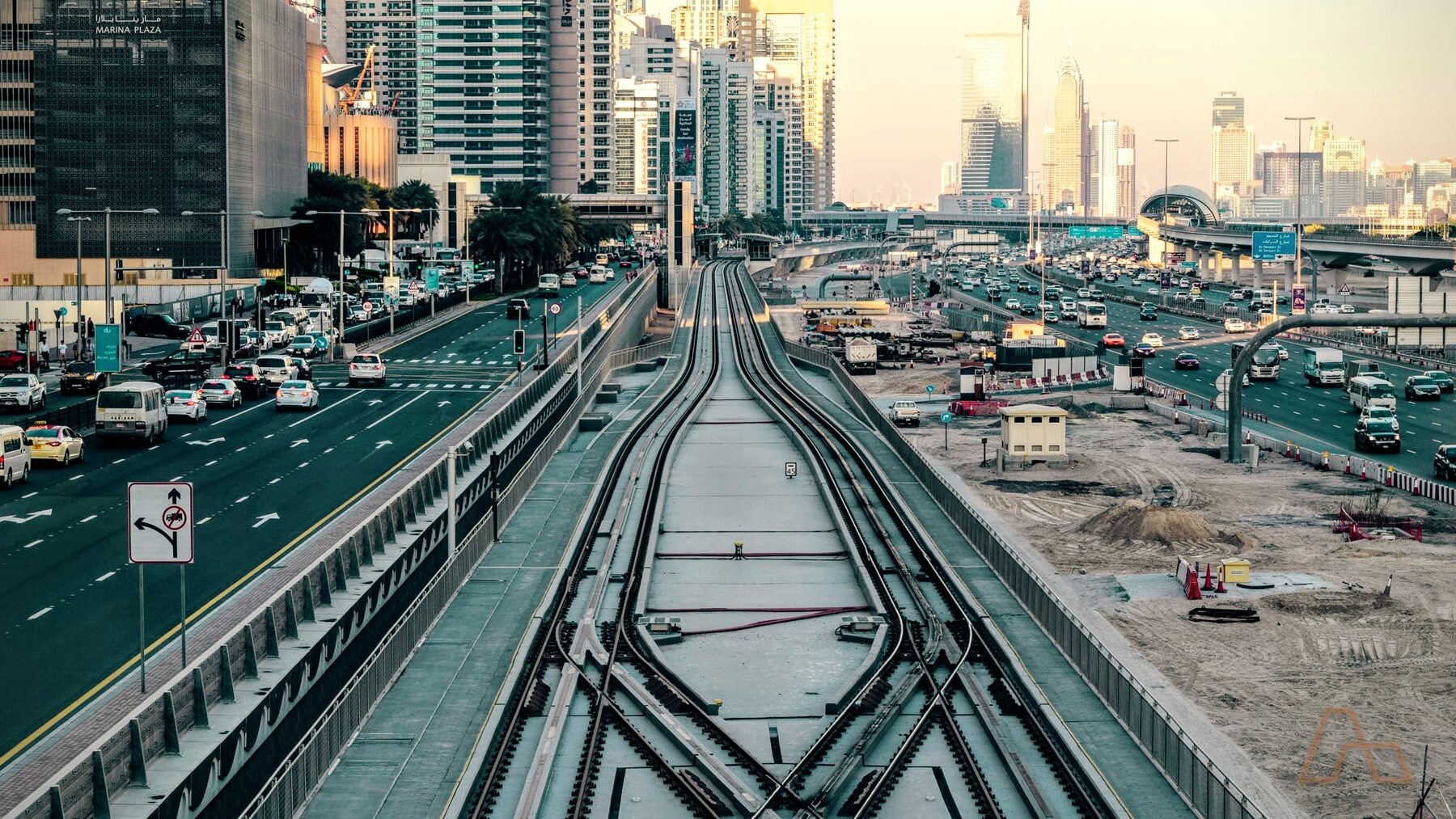
Dubai Metro's Red Line runs along Sheikh Zayed Road and then out past Discovery Gardens, Al Furjan and the Expo corridor. Jumeirah Golf Estates Metro Station, opened as part of the Route 2020 extension, sits on that line. Putting the national rail terminus beside it means a passenger can arrive from Abu Dhabi and continue by Metro to Marina, Downtown or the airport without a car.
That is a genuinely different proposition from the Metro Blue Line, which the archive covers separately. The Blue Line reorganises travel inside Dubai. Etihad Rail changes the cost and friction of living in one emirate and working in another.
The communities in the station's catchment were not designed around it:
- Jumeirah Golf Estates itself, which now hosts the terminus
- Al Furjan and Discovery Gardens, already on the Red Line and the most apartment-heavy stock nearby
- Jumeirah Village Circle and Jumeirah Village Triangle, the volume mid-market districts inland of the corridor
- Dubai Sports City and Arjan, slightly further out but on the same inland axis
- Dubai South and the Expo City district, which gain a second strategic transport anchor alongside Al Maktoum International
None of these were marketed on rail access. That is precisely why the asset is unpriced rather than already reflected in prices.
The Price Effect, Stated Honestly
Transit infrastructure does tend to lift nearby residential values, and Dubai has its own evidence from the Red Line and the Route 2020 extension. But two cautions apply here, and skipping them is how buyers overpay.
The first is that intercity rail is not metro rail. A commuter uses a metro station several times a week. A household uses an intercity station a few times a month at most, unless one earner genuinely commutes to Abu Dhabi. The uplift mechanism is therefore weaker and narrower than Red Line proximity, and it concentrates on a specific buyer: the dual-emirate household that previously had to choose between a Dubai home and an Abu Dhabi job.
The second is that the catchment is inland and car-dependent, with Metro already present. For a JVC or Al Furjan apartment, the marginal change from Etihad Rail is smaller than the Metro already delivered. The clearer beneficiary is the villa and townhouse buyer in Jumeirah Golf Estates and the inland master communities, where an Abu Dhabi commute was previously close to unworkable and is now roughly an hour of seated travel.
Anyone quoting a specific percentage uplift from Etihad Rail on Dubai property is guessing. The station opened weeks ago. There is no transaction series yet that separates a rail effect from the broader market.
What to Check Before You Buy on This Thesis
If the rail link is part of your reason for buying, make it a checkable reason.
- Measure the real door-to-platform time, by car and by Metro, at the hour you would actually travel, not the straight-line distance to the station
- Confirm the pedestrian bridge to Jumeirah Golf Estates Metro Station is open, because without it the interchange is a drive rather than a walk
- Read the current timetable for frequency, not just journey time. Five round trips on launch day is a different commute from a half-hourly service
- Price the total journey, since an Abu Dhabi commute is the fare plus the Metro or taxi legs at both ends plus parking at Al Yalayis
- Treat future stations and any high-speed proposals as unbuilt. Buy on what is operating
On the parking point specifically, a parkway station in an inland district lives or dies on whether you can leave a car there, so verify current capacity and charges directly with Etihad Rail.
The Jumeirah Golf Estates Footnote
The archive's Jumeirah Golf Estates guide covers the community on its own terms, including the detail that every homeowner golf membership category is full with a waitlist and no onboarding timeline. Add the station to that picture and the district's profile has shifted. It was a secluded golf community with Red Line access at its edge. It is now the national rail gateway to Dubai.
For a buyer, this cuts both ways and it is worth being even-handed. A terminus brings traffic, parking demand, and a different kind of visitor flow to the edge of a quiet community. Sellers will frame that purely as upside. The sensible position is that accessibility has improved materially and that the station's immediate surroundings will feel busier than they did, and to look at exactly where a given villa sits relative to the station approach roads.
Two data cautions from that guide still apply here, because they bound any investment case. Listing averages in Jumeirah Golf Estates quote around AED 3,038 per square foot while registered villa sales average nearer AED 2,330, and secondary sources claiming 7% to 9% yields there are wrong. Derived from actual rents it is 4% to 4.5% on villas and 5.5% to 6% on Alandalus apartments.
Questions Buyers Ask
Where is the Etihad Rail station in Dubai?
It is Dubai Al Yalayis Station, located at Jumeirah Golf Estates in the inland southwest of the city, rather than in central Dubai. It connects to Jumeirah Golf Estates Metro Station on the Dubai Metro Red Line by a dedicated pedestrian bridge of around 400 metres, which is what links it into the wider Dubai transport network.
How long does the train from Dubai to Abu Dhabi take?
The published network target is 57 minutes, but launch timetables show closer to 64 minutes, with the first service leaving Al Yalayis at 6.14am and arriving in Abu Dhabi at 7.18am. Use the live timetable rather than the headline target when assessing a commute, and check current frequency as the service expands.
How much does the Etihad Rail Dubai to Abu Dhabi ticket cost?
One-way fares start at AED 39 in Comfort Class and AED 109 in Premium Class. The Dubai to Fujairah route starts at AED 29 Comfort and AED 89 Premium. Fares are booked through the Etihad Rail website and app, and should be budgeted alongside the Metro or taxi legs at either end of the journey.
Will Etihad Rail increase Dubai property prices?
Probably in its immediate catchment, but no credible figure exists yet because the station only opened on 30 September 2026 and there is no transaction series that isolates a rail effect. The strongest case is for villas and townhouses in Jumeirah Golf Estates and the inland master communities, where an Abu Dhabi commute moves from impractical to about an hour.
Which Dubai areas benefit most from Etihad Rail?
Jumeirah Golf Estates most directly, since it hosts the terminus, followed by the Red Line inland corridor of Al Furjan and Discovery Gardens, the Jumeirah Village districts, Dubai Sports City and Arjan, and Dubai South with Expo City. For the apartment districts already served by Metro the marginal gain is smaller, because the Metro had already solved their connectivity.
The Short Version
Dubai's Etihad Rail terminus is Dubai Al Yalayis Station at Jumeirah Golf Estates, and passenger service started on 30 September 2026. Fares to Abu Dhabi start at AED 39, journey time runs to roughly 64 minutes on launch timetables against a 57-minute target, and a pedestrian bridge of around 400 metres links it to the Red Line.
The property angle is narrow but real. This asset mainly benefits households that want a Dubai home and an Abu Dhabi job, and the clearest beneficiaries are the inland villa and townhouse communities where that combination used to be unworkable. For apartment districts already on the Red Line, the Metro had already done most of the work.
Buy on the operating timetable, not on future stations or high-speed proposals, and verify the bridge, the frequency and the parking before you treat a rail commute as real. Anyone quoting you a percentage uplift from this station is inventing it.