Dubai has no income tax. That is the headline, it is true, and it is where most cost-of-living research stops — which is why so many new residents arrive with a budget that is wrong by a few thousand dirhams a month.
The gap is never the rent. People research rent carefully. The gap is three charges that do not exist in most countries: a municipality housing fee added to your electricity bill, a district cooling bill that arrives whether you are home or not, and a rental market that still expects a year of rent in one or two cheques.
This guide sets out what a household actually spends in Dubai in 2026, which lines are fixed and which you control, and the specific bills that catch people out.
Housing Comes First, and It Sets Everything Else
In most Dubai household budgets, housing is 30% to 40% of total spending, and it drives three other lines with it: the housing fee is a percentage of your rent, the cooling bill scales with the size of the home, and the community you pick decides whether you need one car, two, or none.
Choosing the home is therefore most of choosing the budget. A couple in a two-bedroom in Jumeirah Village Circle and a couple in a two-bedroom in Dubai Marina are not AED 40,000 a year apart. Once the housing fee, the chiller, the parking and the commute are counted, they are closer to AED 60,000 apart.
The Three Bills New Residents Miss
The municipality housing fee, 5% of annual rent. Dubai Municipality levies a housing fee calculated at 5% of annual rental value, collected in twelve monthly instalments through your DEWA bill rather than as a separate invoice. On a rent of AED 90,000 that is AED 375 a month. Tenants pay it on the rent in their Ejari contract. Owner-occupiers pay it on an assessed rental value for the property, which is why a DEWA bill in an owned apartment still carries a municipality line. It is not a billing error, and almost nobody budgets for it.
District cooling, with a charge that does not depend on use. Many Dubai buildings are cooled by a central provider such as Empower or Emicool rather than by an air conditioner you control. Those bills typically include a fixed capacity or demand charge payable regardless of consumption — which is why a bill still arrives for a month you spent abroad. Budget AED 300 to AED 700 a month for a one-bedroom and AED 700 to AED 2,000 for a villa, on top of DEWA.
Rent in advance, in one or two cheques. The cost is the same but the cashflow is not. Many landlords still prefer one or two cheques for the year, and while four or six is increasingly common, better properties are let on fewer. Arriving in Dubai means being able to produce a large part of a year's rent at once, plus a 5% agency commission, a security deposit of around 5% of annual rent, the Ejari fee and the DEWA deposit. A first month in Dubai routinely costs more than three ordinary months.
What the Utilities Actually Cost
| Item | Typical monthly cost |
|---|---|
| DEWA, one-bedroom apartment | AED 350 to 700 |
| DEWA, three-bedroom villa | AED 1,200 to 3,000 |
| District cooling, one bedroom | AED 300 to 700 |
| District cooling, villa | AED 700 to 2,000 |
| Internet | AED 300 to 600 |
| Housing fee, on AED 90,000 of rent | AED 375 |
| Mobile plan, per person | AED 100 to 250 |
DEWA charges a refundable security deposit on connection — around AED 2,000 for an apartment and AED 4,000 for a villa. Internet is the line with the least choice in it: many towers are wired for a single provider, so check whether Etisalat or du serves your building before you choose a package.
Schools Are the Largest Single Line for a Family
For a household with children, school fees usually exceed every other category including rent. Dubai's schools are regulated by the KHDA and fees vary by curriculum and by rating far more than by location.
| School tier | Indicative annual fee, per child |
|---|---|
| Budget, including many Indian and Pakistani curriculum schools | AED 8,000 to 25,000 |
| Mid-market British, American or IB | AED 35,000 to 70,000 |
| Premium British or IB | AED 70,000 to 110,000 and above |
Two children in a mid-market British school is AED 70,000 to AED 140,000 a year, before uniforms, transport and activities. Any relocation calculation for a family that does not start here is not a calculation.
A Monthly Budget, Three Households
Indicative 2026 figures, for a household renting in a mid-market community rather than a prime one. Treat them as a planning range.
| Line | Single, one bedroom | Couple, two bedroom | Family of four, three-bedroom townhouse |
|---|---|---|---|
| Rent | AED 5,400 | AED 8,300 | AED 14,200 |
| Municipality housing fee | AED 270 | AED 420 | AED 710 |
| DEWA | AED 500 | AED 700 | AED 1,200 |
| District cooling | AED 450 | AED 650 | AED 900 |
| Internet | AED 400 | AED 400 | AED 450 |
| Mobile | AED 150 | AED 300 | AED 400 |
| Groceries | AED 1,200 | AED 2,500 | AED 4,500 |
| Transport | AED 800 | AED 2,000 | AED 3,000 |
| School fees, two children | — | — | AED 7,500 |
| Eating out and leisure | AED 1,000 | AED 1,800 | AED 2,000 |
| Monthly total | about AED 10,200 | about AED 17,100 | about AED 34,900 |
Those totals assume no savings, no annual flights home, and no health insurance premium — most employers cover insurance, and a household paying its own runs AED 600 to AED 2,500 a month depending on cover and age.
Where the Money Goes That You Can Control
Transport. A car is close to essential outside the metro corridor, and that is a choice made when you pick the community rather than when you buy the car. Petrol is cheap by European standards. Salik road tolls, Dubai's parking charges and comprehensive insurance are not. Living within walking distance of a metro station is the single largest controllable saving in a Dubai budget.
Groceries. The spread between Carrefour or Union Coop and a premium supermarket on imported goods is large — frequently double. Households that shop at the former and buy regional produce rather than imported spend a fraction of what the "Dubai is expensive" reputation suggests.
Eating out. This is where Dubai budgets actually break. The city is built around hospitality and the marginal cost of a social life here is higher than in most places. It is also the most elastic line in the table.
Alcohol. Licensed retail carries duty and restaurant pricing is high. For households that drink, this can be a four-figure monthly line, and it is the item most often omitted from relocation budgets.
What Dubai Does Not Charge You
Worth stating plainly, because it is the real offset against the lines above.
- No personal income tax. Salary is received gross.
- No annual property tax, no council tax and no rates. The only recurring government-linked charge on a home is the 5% housing fee.
- No capital gains tax for individuals.
- VAT at 5%, which is low by international comparison and already included in most displayed prices.
A household earning AED 30,000 a month keeps AED 30,000 a month. In most of Europe the equivalent gross would be reduced by a third or more before it reached the account. That difference is the whole economic case for living here, and it is large enough to absorb a lot of chiller bills.
Frequently Asked Questions
How much money do you need to live comfortably in Dubai?
As a 2026 planning range for a mid-market community: roughly AED 10,000 to AED 12,000 a month for a single professional in a one-bedroom, AED 17,000 to AED 20,000 for a couple in a two-bedroom, and AED 33,000 to AED 40,000 for a family of four with two children in a mid-market school. Those figures cover living costs without savings, annual flights home or self-funded health insurance.
What is the 5% housing fee on a Dubai DEWA bill?
A Dubai Municipality charge of 5% of annual rental value, collected in twelve monthly instalments through the DEWA bill rather than invoiced separately. Tenants pay it on the rent stated in their Ejari contract; owner-occupiers pay it on an assessed rental value for their property. On a rent of AED 90,000 it is AED 375 a month. It is a standard line, not an error.
Is Dubai really tax free?
There is no personal income tax, no annual property tax and no capital gains tax for individuals, so salary is received gross. There is VAT at 5% on most goods and services, a 5% municipality housing fee on residential rental value, and various government service fees. Many residents also remain taxable in their home country on worldwide income, which is a separate question worth professional advice.
How much are utilities in a Dubai apartment?
For a one-bedroom, roughly AED 350 to AED 700 a month for DEWA, AED 300 to AED 700 for district cooling where the building uses it, AED 300 to AED 600 for internet, and the housing fee at 5% of annual rent divided over twelve months. A three-bedroom villa runs AED 1,200 to AED 3,000 on DEWA alone.
Why does my Dubai cooling bill arrive when I am away?
Because district cooling bills typically include a fixed capacity or demand charge payable regardless of consumption. The provider — commonly Empower or Emicool — is supplying chilled water capacity to your unit whether or not you draw on it, so a bill arrives even for an empty month. Only the consumption portion falls when you are away.
How much are school fees in Dubai?
Indicatively, AED 8,000 to AED 25,000 a year per child at the budget end including many Indian and Pakistani curriculum schools, AED 35,000 to AED 70,000 for mid-market British, American or IB schools, and AED 70,000 to AED 110,000 and above at premium schools. Fees are regulated by the KHDA and vary with curriculum and school rating more than with location.
Do you need a car in Dubai?
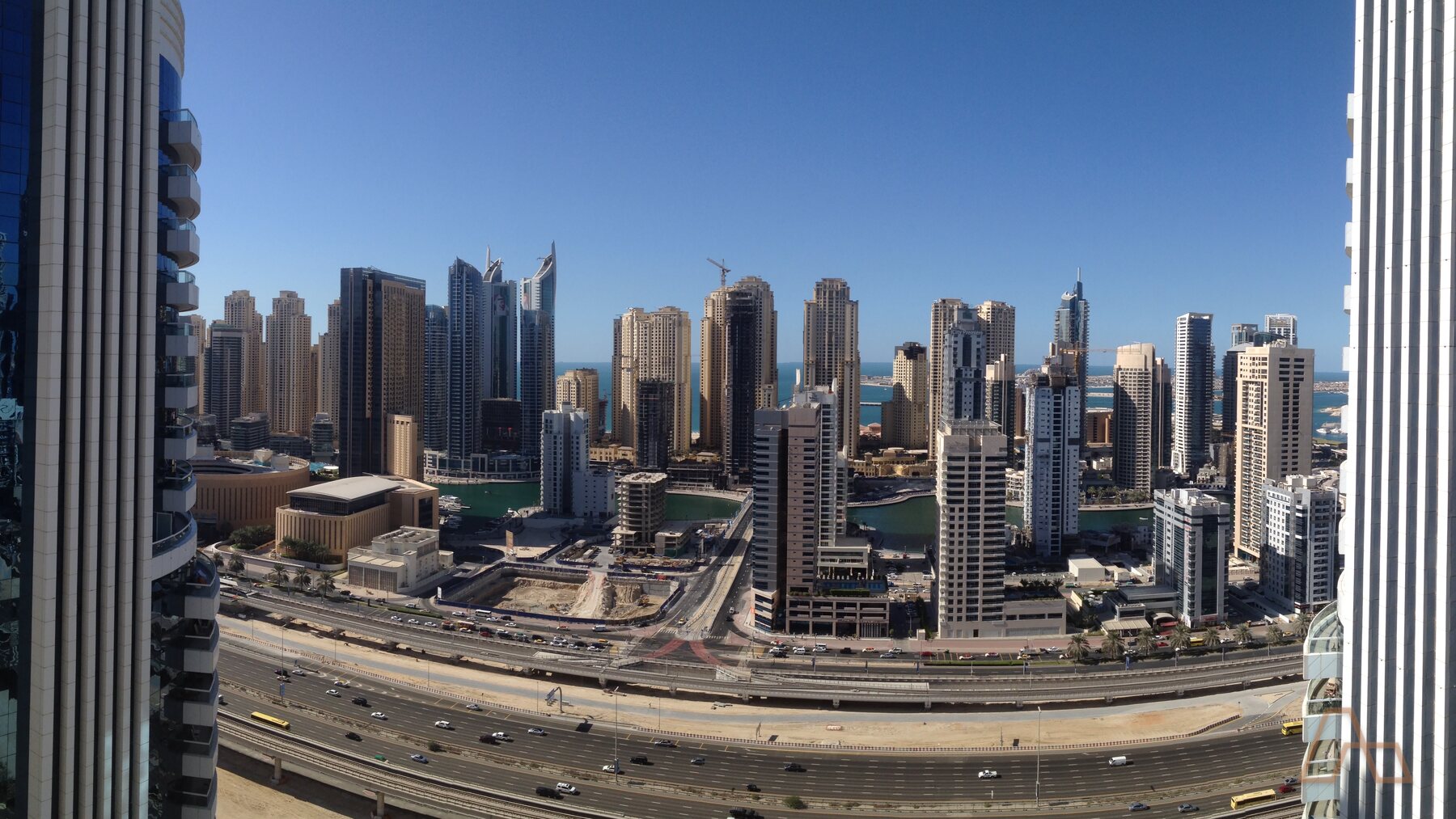
Not if you live on the metro corridor — Dubai Marina, JLT, Business Bay, Downtown, Al Furjan and parts of Deira are all workable without one. Outside those corridors a car is close to essential, because the city is designed around driving and walking distances between communities are long and hot for much of the year. The decision is effectively made when you choose the community.
How many rent cheques do Dubai landlords accept?
Four or six cheques is increasingly common, but one or two is still frequent and better properties are often let on fewer. Fewer cheques will usually secure a lower rent. The practical consequence for a new arrival is cashflow rather than cost: budget for a large share of a year's rent up front, plus roughly 5% agency commission, a security deposit of about 5% of annual rent, the Ejari fee and a DEWA deposit of AED 2,000 to AED 4,000.
Is it cheaper to live in Sharjah and work in Dubai?
Rent in Sharjah and Ajman is materially lower, which is why many households do it. The offsets are the commute, which can run well over an hour each way at peak times, Salik tolls, fuel and vehicle wear, and the fact that Sharjah is a different emirate with its own rules. For a single earner with a flexible schedule it can work well. For a dual-income household with school runs it frequently does not.
What is the biggest hidden cost of living in Dubai?
For families, school fees, which routinely exceed rent. For everyone else, the combination of the 5% municipality housing fee and the district cooling capacity charge, because neither exists in most countries and neither appears in rent research. Together they commonly add AED 700 to AED 2,500 a month to a budget built from the rent figure alone.
Where This Leaves You
Build the budget from the home, not from the salary. The rent figure determines the housing fee, the cooling bill, the parking, the commute and whether you need a second car — so a community decision is a budget decision, and it is worth making with the full monthly number in front of you rather than the annual rent.
The three lines to add to any Dubai budget you have already built: 5% of annual rent as a housing fee, a district cooling bill that does not stop when you travel, and school fees before anything else if you have children.
If you are relocating and want help matching a monthly budget to the communities it actually works in, including the service charge and chiller position on specific buildings, our team can take that on.