Dubai is building a third metro line, and it is the first one aimed inland rather than along the coast. The Blue Line was approved in November 2023, carries a budget of AED 18 billion, and is scheduled to open on 9 September 2029 — the twentieth anniversary, to the day, of the metro's first journey. Construction passed roughly a quarter complete during 2026.
For a property buyer the interesting thing is not the engineering. It is that the line runs through districts that have spent fifteen years being described as "affordable because they are far from the metro". That sentence stops being true in 2029, and the market has started to price the change unevenly, which is where the opportunity and the mistake both live.
The Route, Station by Station
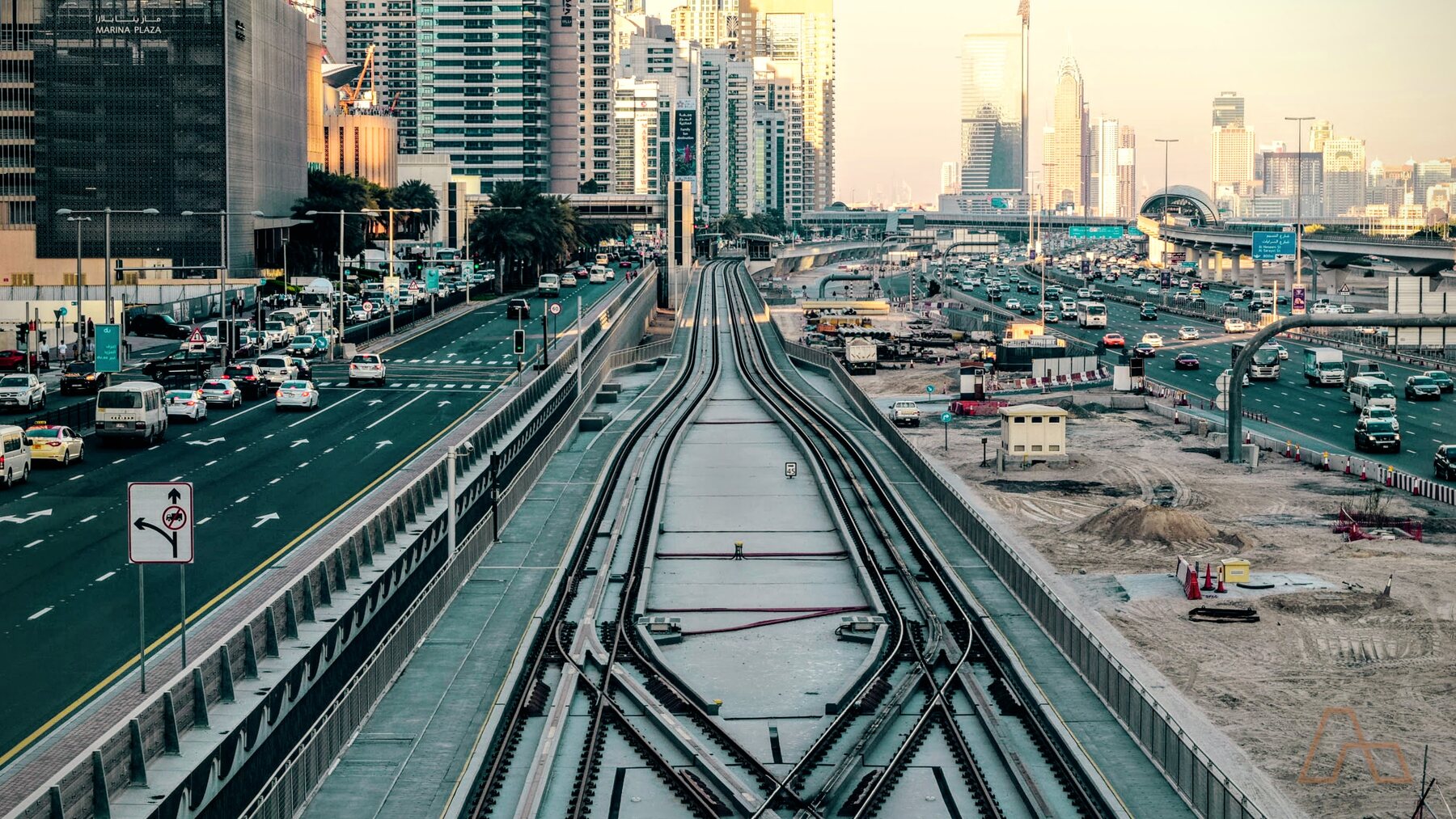
Thirty kilometres, 14 stations, with 15.5 kilometres underground across five stations and the remainder elevated across nine. The line is shaped as a Y: two branches meet at International City, one running north-west to Creek, the other north to Centrepoint.
| Station | District it serves | Note |
|---|---|---|
| Creek | Dubai Creek, Al Jaddaf | Interchange with the Green Line |
| Dubai Festival City | Festival City, Al Kheeran | |
| Dubai Creek Harbour | Creek Harbour | |
| Dubai Square | Creek Harbour retail district | |
| Ras Al Khor Industrial | Ras Al Khor | |
| Car Mart | Ras Al Khor, Nad Al Hamar edge | |
| International City 1 | International City | Y-junction between the two branches |
| International City 2 | International City, Warsan | |
| Dubai Silicon Oasis | Silicon Oasis, Academic City edge | |
| Academic City | Academic City, Dubailand Residence Complex | Southern terminus |
| Dragon Mart | International City, Warsan | |
| Al Warqa | Al Warqa | |
| City Centre Mirdif | Mirdif, Uptown Mirdif | |
| Centrepoint | Al Rashidiya | Interchange with the Red Line |
Two pieces of infrastructure stand out. The line crosses Dubai Creek on a 1.3 kilometre bridge, the first metro crossing of the creek. And the Emaar Properties station at Creek Harbour will be, at 74 metres, the tallest metro station in the world. The Roads and Transport Authority's stated target is 320,000 passengers a day by 2040, with journey times of 25 minutes from Creek to Academic City and 17 minutes from Centrepoint to Academic City.
What Transit Proximity Actually Does to Price
Here is where most coverage overclaims. The honest position is that a metro station reliably changes two things and unreliably changes a third.
It changes the tenant pool. This is the strongest and least disputed effect. A building within a walkable radius of a station recruits from everyone who does not own a car, which in Dubai is a large and structurally growing segment. The effect shows up first in occupancy and void periods, not in headline rent — a landlord near a station spends fewer weeks empty.
It changes rent before it changes capital value. Rental premiums for walkable metro access in the established Dubai corridors have historically run in the region of 5% to 12% over otherwise comparable stock, widening for studios and one-bedrooms and narrowing almost to nothing for large family units, whose occupants drive anyway.
It changes capital value only where the station fixes a real deficiency. A station near Dubai Marina adds a convenience to a district that was already well connected. A station at Al Warqa or Mirdif introduces a service that genuinely did not exist. The second case re-rates the ground. The first mostly does not.
So the test for any Blue Line district is not "is a station coming" but "what does this district lack today that the station supplies".
District by District
International City and Warsan. Three stations, including the junction. This is the largest change on the line in percentage terms. International City is Dubai's deepest pool of genuinely low-priced apartments, with gross yields that have long sat among the highest in the city precisely because access is poor and the building stock is dated. A metro connection removes the main structural objection. The caveats are real: much of the stock is ageing, service charge quality varies sharply between clusters, and the district's price discount reflects more than transport. Buy the specific building, not the postcode.
Mirdif and Al Warqa. Established, low-rise, family-dominated, and until now effectively car-only. Mirdif in particular has a resident base that has never had a rail option. The honest read is that these are rental-demand stories rather than price-explosion stories — the housing is mostly villas and low-rise apartments occupied by families with cars, so the station improves liveability and tenant depth more than it re-rates land. Uptown Mirdif and the apartment stock around City Centre Mirdif benefit most.
Dubai Silicon Oasis and Academic City. The strongest fundamental case on the line. These districts house a large student and young-professional population on modest budgets, which is exactly the segment for which a metro connection is transformative rather than convenient. Silicon Oasis already has reasonable yields and a deep rental market. A 17-minute ride to a Red Line interchange changes the commuting map for tens of thousands of people who currently take two buses.
Dubai Creek Harbour and Dubai Square. Two stations, and the one place on the line where the metro was always in the plan. The result is that it is substantially priced in already. Creek Harbour has been sold on future connectivity since launch, so a buyer today is not capturing an unpriced change — they are buying a master community whose delivery risk, supply pipeline and service charges deserve more attention than its station. We cover the district in detail in our Dubai Creek Harbour area guide.
Festival City and Al Jaddaf. A quieter beneficiary. Al Jaddaf has absorbed a lot of mid-market apartment supply and sits close to the Creek interchange with the Green Line, which turns a single-line connection into a network one. Festival City's residential component is small relative to its retail, so the effect concentrates in a handful of buildings.
Ras Al Khor. Two stations serving an area that is predominantly industrial and a wildlife sanctuary. Not a residential play today. Worth watching only as a rezoning question over a long horizon.
The Timing Problem
A 2029 opening creates an awkward arithmetic for anyone buying now specifically to capture it.
- The announcement effect is spent. Routes and station locations have been public since 2023 and 2024. The easy re-rating from "there might be a line" to "there is a line, here is the map" has already happened.
- The construction years are the drag. Districts along the alignment face several years of road diversions, hoardings and noise before any of the benefit arrives. That weighs on rents in exactly the buildings closest to the stations.
- The opening effect concentrates in the last 12 to 18 months. Historically, transit premiums in Dubai firm up as an opening becomes credible and tangible, not when the contract is signed.
Which argues for a specific posture rather than a general one. If you are buying a hold to 2030 and beyond, proximity to a Blue Line station is a genuine quality factor and worth paying something for today. If you are buying a two-year flip on the metro story, the story has already been told and you are more likely to buy the construction disruption than the opening.
The practical filter is walking distance. The premium attaches to five to eight minutes on foot from an entrance, in shade, across no more than one major road. A building 1.5 kilometres from a station in a district with no pedestrian infrastructure captures very little of the effect, regardless of what the brochure map implies.
Frequently Asked Questions
When does the Dubai Metro Blue Line open?
The Blue Line is scheduled to open on 9 September 2029, the twentieth anniversary of the Dubai Metro's launch. It was approved in November 2023 and construction was approximately 25% complete through 2026. As with any project of its scale, a buyer should treat the date as a target rather than a certainty.
Which areas does the Dubai Metro Blue Line serve?
Fourteen stations across nine districts: Dubai Creek and Al Jaddaf, Dubai Festival City, Dubai Creek Harbour, Ras Al Khor, International City and Warsan, Dubai Silicon Oasis, Academic City, Al Warqa, Mirdif and Al Rashidiya. It interchanges with the Green Line at Creek and with the Red Line at Centrepoint.
How long is the Dubai Metro Blue Line?
Thirty kilometres with 14 stations, of which 15.5 kilometres and five stations are underground and the balance elevated. It includes a 1.3 kilometre bridge across Dubai Creek, the first metro crossing of the creek, and the Emaar Properties station at Creek Harbour will be the world's tallest metro station at 74 metres.
Will the Blue Line increase property prices in International City?
It removes the district's main structural disadvantage, and three of the fourteen stations sit in or beside it, so the direction of effect is positive. The size is less certain than the direction. International City's discount reflects building age and service charge quality as well as access, and a metro station does not fix either. The effect should show up first in occupancy and rental depth rather than in headline capital values.
Does being near a Dubai Metro station increase rent?
Yes, modestly and unevenly. Walkable metro access in Dubai has historically supported rental premiums in the region of 5% to 12% over comparable stock, strongest for studios and one-bedrooms and weakest for large family units whose occupants drive. The more reliable benefit to a landlord is shorter void periods rather than a higher headline rent.
Is it too late to buy ahead of the Blue Line?
For a long hold, no — the opening premium historically firms in the final 12 to 18 months before service begins, and that is still ahead. For a short-term trade, largely yes: the route and station locations have been public since 2023, so the announcement re-rating is spent, and the intervening years carry construction disruption in the districts closest to the alignment.
Which Blue Line district has the strongest investment case?
On fundamentals, Dubai Silicon Oasis and Academic City, because their resident base is young, budget-conscious and disproportionately dependent on public transport, which is the segment for which a rail connection is transformative rather than merely convenient. Creek Harbour has the best-quality stock on the line but has been priced on its future connectivity since launch.
Where This Leaves a Buyer
The Blue Line is a real change to Dubai's residential geography, and it is concentrated in the half of the city that off-plan marketing usually ignores. But it is not a uniform uplift, and the districts where the headline is loudest are mostly the ones where the price already reflects it.
The useful question is narrow: does this specific building sit within a genuine walk of a station, in a district where the station supplies something that is currently missing? Where the answer is yes — parts of Silicon Oasis, the better International City clusters, the apartment stock around Mirdif — there is value that is not yet fully in the price. Where the answer is no, the line is a nice feature on a brochure and nothing more.
If you want a specific building assessed against its nearest Blue Line station, including the walking route rather than the straight-line distance, our team can run it.